About
About
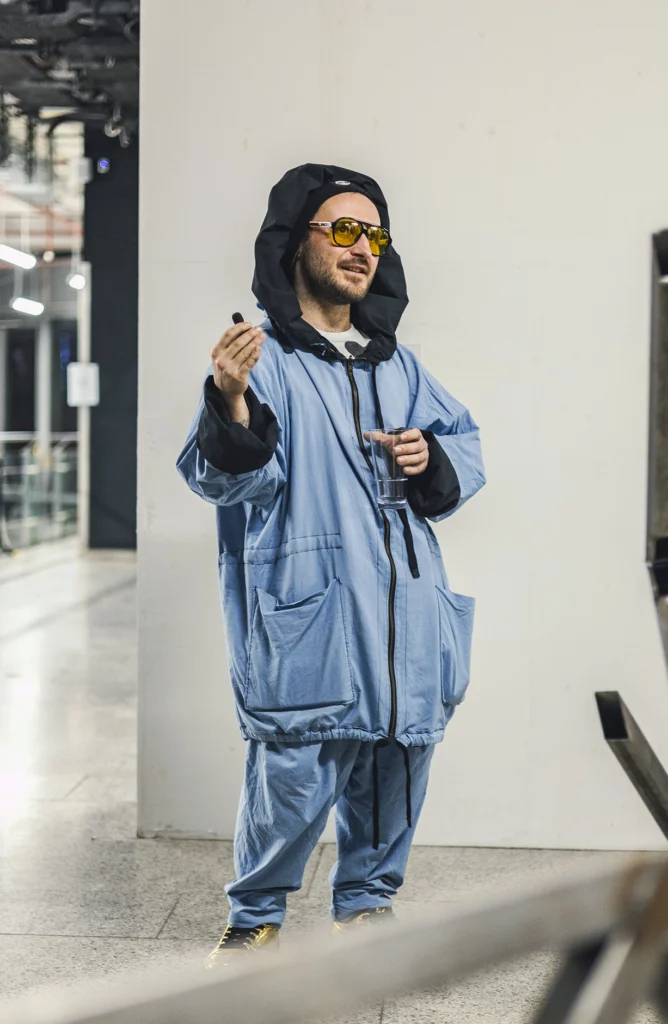
Piotr Kolanko (b. 1987 in Jasło, Poland) is a visual artist working across painting, drawing, steel sculpture, mural and immersive media. He lives and works in Kraków.
The practice focuses on processes through which experience is transformed into form, and form into meaning. Its point of departure is the trace, understood as the most elementary record of presence.
Jasło — the artist's hometown, almost entirely destroyed during the Second World War and subsequently rebuilt — remains an important point of reference. Its history is not treated as an illustrative subject, but resonates structurally with processes present throughout the practice: construction, destruction, absence, reconstruction, and memory.
Solo exhibitions
Selected group exhibitions
Public space commissions
Intermedia installations
Residencies
Exhibitions in public institutions marked in blue.
Artist statement
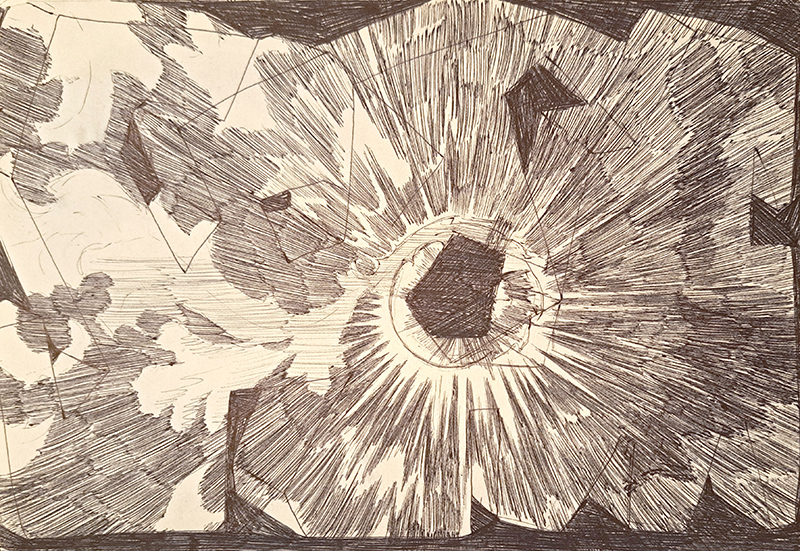
Piotr Kolanko's practice focuses on processes through which experience is transformed into form, and form into meaning. Its point of departure is the trace, understood as the most elementary record of presence. A trace may develop into a line; a line may establish a shape; and a shape, once it begins to represent a recognizable object, may become a sign. Symbol, however, does not constitute another stage of formal development. It is a cultural dimension of form: it may emerge at any level of this structure when form activates meanings, tensions, and contradictions rooted beyond representation itself.
Kolanko approaches reduction not as a simplification of meaning, but as a method of condensation. A realistic representation and a radically reduced sign may refer to the same object; the difference emerges when an intervention in its structure opens a new field of interpretation. Formally there may be less, while semantically there may be more.
The second axis of the practice concerns what happens when the sign ceases to exist in isolation. Repetition and mirroring may reveal possibilities latent within form; ornament develops into an attempt to establish a system, accumulation introduces rhythm and time, while proliferation gradually erodes the autonomy of distinct meanings. In overload, the process reaches a paradoxical point at which maximum complexity leads to radical reduction: forms and meanings merge into a shared surface, texture, material trace. The process comes full circle.
Painting, drawing, mural, sculpture, object, environment, and digital space do not operate as separate practices. They are successive states of materialization within the same process. A drawing may be transformed into a vector, an object, a spatial structure, or a monumental realization, and subsequently subjected again to reduction, destruction, or further transformation.
Jasło — the artist's hometown, almost entirely destroyed during the Second World War and subsequently rebuilt — remains an important point of reference. Its history is not treated as an illustrative subject, but resonates structurally with processes present throughout the practice: construction, destruction, absence, reconstruction, and memory. A form may cease to exist without ceasing to be present; a trace may become the presence of what no longer exists in its original form.
Kolanko's practice is recursive. Construction and deconstruction are not opposing operations, but two directions of the same process. Making thus becomes an instrument of inquiry — a way of examining relations among experience, perception, form, culture, and memory.